Understanding China
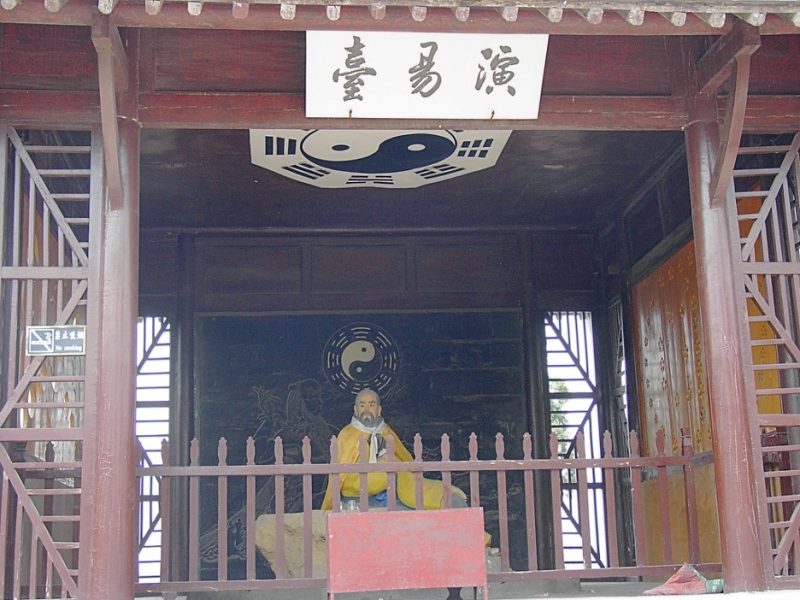
The temple of King Wen, Youli townlet, Anyang City, Henan Province
“Truth does not depart from human nature. If what is regarded as truth departs from human nature, it may not be regarded as truth.” – Confucius
Dr. Lin Yutang begins his book, My Country and My People [1], with Confucius’s quotation on truth and pondering how to describe his country and people best. He goes on to describe a way to understand foreign cultures.
“For this work there is need for broad, brotherly feeling, for the feeling of the common bond of humanity and the cheer of good fellowship. One must feel with the pulse of the heart, as well as see with the eyes of the mind. “
We feel humility and become humble when we abandon our attachments to our preconceptions of how the world works. This is the “brotherly feeling” Dr Yutang writes of. Humility brings us joy in the discovery that learning brings and joy for those we listen to because they feel understood by us. Understanding is not a claim we make from listening to others. It is a claim those we listen to make about the quality of our listening and understanding. This understanding brings us trust and collaboration.
Understanding China requires humility, which is not hard to feel. When Goran Carstedt and I visited Anyang in Henan Province, we were immersed in the rich history of Chinese civilization. In 2000 BC, Anyang, then Yin, was one of four capitals of Henan. The first Chinese characters in this region were discovered written on tortoise shells as the bronze age emerged. It was easy to be humble when I stepped into this cradle of Chinese civilization. Consider this: around 1100 BC, Anyang’s King Wen of Zhou developed the I Ching (Book of Changes) to understand nature’s changes. This inspired Leibniz to develop binary mathematics in 1700 AD, which became the language of the digital age we live in today. While Western culture has developed binary mathematics for over 300 years, the Chinese have done so for over 3,000 years. In the Western world, binary mathematics has created the internet, social media, and alternative realities. In 1100 BC the Chinese used binary mathematics to understand nature.
So, how do we see China during these times of climate change, and what urgent actions does it call for?
Chuang Tzu tells a fable that is essential for understanding the nature of nature. In the fable, a stork’s legs are put on a duck’s body while the duck’s legs are put on the stork. The fable’s lesson is simple: When nature is altered, suffering occurs.
This brings us back to Dr Yu-Lan’s questions. What is the best way to learn from China and her eons of history and development?
Born in the 6th century BC, Lao Tzu describes China’s ancient theory of social learning, a guide for understanding China that is as valid today as when it was written in the Dao De Jing.
“He who knows does not speak.
And he who speaks does not know.” [2]
This way of learning requires detachment, such as the detachment that leads us to humility. One must put aside one’s views of the world and quell the impulse to theorize, analyze, or deduce.
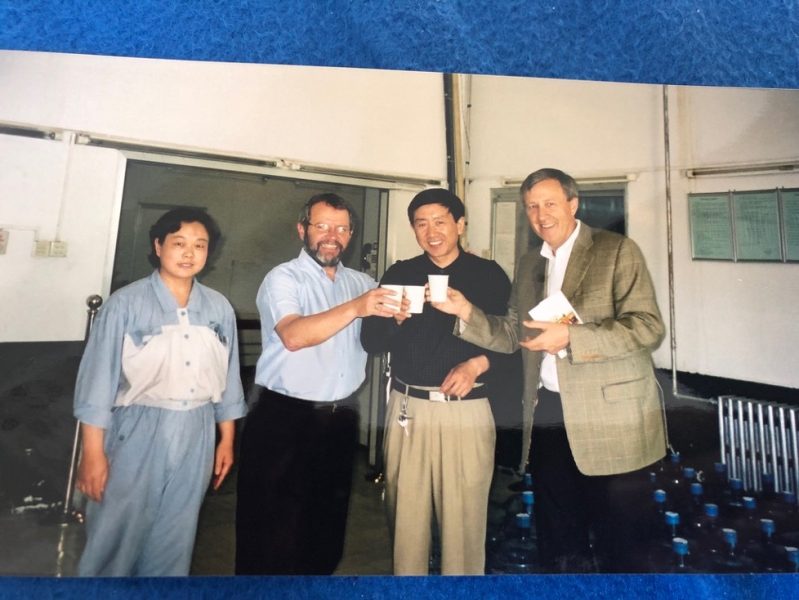
My practice of this detachment has been influenced by the Chinese concept of wu-wei, or action arising from non-action. In the photo below, toasting his company’s water purification achievements with Goran and me is Mr. Fan Tang He, the Human Resource Manager for the Henan Ancai Hi-tech Company. A year after this photo was taken, Mr. Fan and I visited Anhui Jianghuai Automobile Group Corporation in Hefei, Anhui Province. I invited Mr. Fan to practice my social action research with me and watched him quickly learn and apply my practice, causing me to ask him how he did so. I was so impressed. He answered, “Last night I emptied my mind so I would have no expectations and could learn.”
This approach to learning might frustrate Westerners who find value in a mechanical world philosophy that divides the world into fragments of fragments through analysis.
What can come of practicing detachment and seeing China as she is?
Back in Anyang and the Henan Ancai Hi-tech Company, we learned how workers recycled 80% of their wastewater and produced pure drinking water. As the company grew by 20%, the Water department reduced water consumption by 240,000 tons (33%) and over the previous five years, the Water department’s wastewater recycling grew from 83% to 93% with a goal of reaching 95%. Every hour, 24 hours/day, they recycle 2,000 cubic meters of water, preventing 48,000 cubic meters of wastewater from entering Anyang’s aquifer. Adding a water treatment process to their recycling program the Water department produces 7,500 gallons of pure drinking water every month.
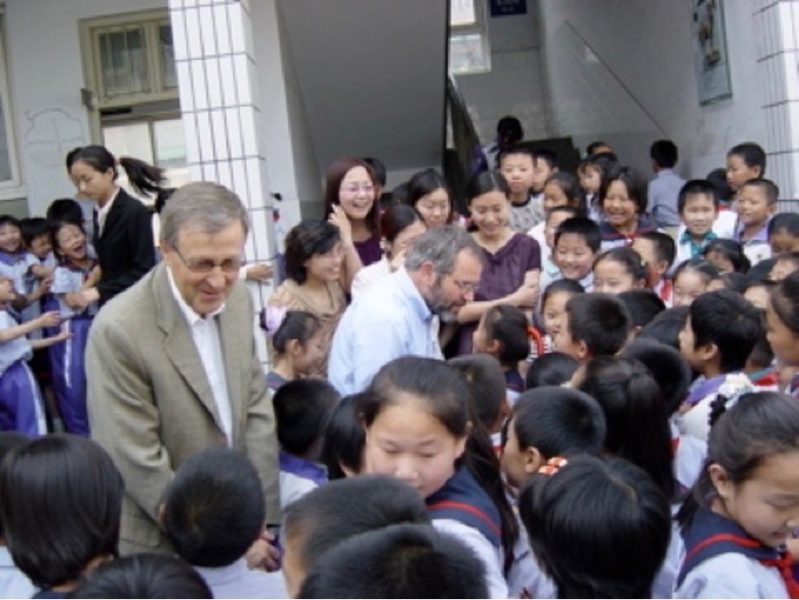
Henan Ancai Hi-tech Company also sponsored the Yin Du Experimental Elementary School, where we visited classrooms bursting with love, creativity, and joy as the teachers taught art, music, and English. We enjoyed a recess break spent in smiles, laughter, and the pleasure of being together.
I could feel the Chinese inviting me to experience de, or virtue as we might call it in the West. You might recognize the Chinese word de from the Taoist classic, Dao De Jing [3]. Chapter 38 discusses detachment as a virtue.
“The man of superior De is not conscious of his De.
And in this way he really possesses De.
The man of inferior De never loses his sight of his De.
And in this way he has no true De.
The man of superior De takes no action.
And thus nothing will be undone.
The man of inferior De takes action.
And thus something will be left undone.”
Whether we are aware of it or not, we approach learning from China with our own theory of knowledge. Do we view knowledge as largely intrinsic and augmented by educational attainment? Is our own theory of knowledge anchored in the bedrock of the industrial age and scientific materialism? Chilean biologists Humberto Maturana and Francisco Varela couple knowing with doing, and Humberto taught us that the path of our ancestry, reaching back through the history of humankind, has brought us to the moment we live in through the conservation of coherences, the quality of our wholeness. He explained that we cannot understand wholeness by applying deductive reasoning and analysis.
Back in 1939, Dr. Fung Yu-Lan describes the experiences Goran, and I shared visiting Anyang and discovering the transformation of wastewater into pure drinking water, the education of children and the ancient history of Anyang.
Thus is the state of pure experience, what is known as the union of the individual with the whole is reached. In this state, there is unbroken flux of experience, but the experiencer does not know it. He does not know that there are things, to say nothing of making distinctions between them. There is no separation of things, to say anything about the distinction between subject and object, and between the “me” and the “non-me”. So in this state of experience, there is nothing but the one, the whole. [4]
Educators, evaluators, systems thinkers, and practitioners of organizational learning and development from the West visiting China might begin by asking “From where do we ground our learning practices?” What is our theory of knowledge? Is it time to question our history of a mechanistic view of the world in favor of a naturalistic view of the Chinese, which has been cultivated for over 3,000 years? After all, humans are natural animals. We are not part of nature. We are nature. Listening, understanding, trusting, and collaborating come naturally to us and need not be taught, trained, modeled, or mathematically abstracted.
1. Yutang, L., My Country and My People. 1935, NY: Halcyon House.
2. Tzu, L., Tao te ching. 1963, New York, NY: Penguin Books. 192.
3. Keping, W., The Classic of the Dao: A new investigation. 1998, Beijing: Foreign Languages Press.
4. Yu-lan, F., A Taoist Classic: Chuang Tzu. Vol. Foreign Languages Press. 1989, Beijing.